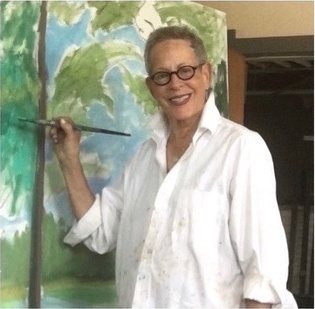
Artist in Residence, K12 Tejas
I am a serious artist who studied for 18 years with a master teacher, Roland Huston, in Cincinnati from 1987 to 2005. I have been painting for 38 years. I completely understand what the modern masters were doing, i.e. creating a "language" emphasizing solid structure when developing a painting from the "inside out." Going beyond intuitive instincts is the greatest challenge I encourage my students to think about, to study and to implement in their paintings.
I was born to be an Artist....
I knew at a young age that I had a passion for drawing. In my 8th grade I won a contest depicting the "Lady & the Tramp" characters in the Cincinnati Enquirer. I won a bicycle with handlebar brakes.
As I proceeded through school, I was exposed to generous amounts of figure drawing that thrilled my soul. I had a natural instinct for fashion, enjoying a position on Pogue's first Teen Fashion Board as a junior in high school in 1958. Thus it was natural to pursue a degree in Fashion Illustration at the University of Cincinnati in 1960. In 1963 I met my husband George, and 8 years later our 5 young children made my heart sing with the joy of motherhood.
Paul Chidlaw
In 1980, through an amazing turn of events (that I will discuss later), I met Paul Chidlaw (whom I was aware of by reading about him in the art section in the Cincinnati Enquirer) and visited his studio. I was excited to understand what Paul (at age 80) knew about painting. He told me that he started with a white surface, and, almost magically, stroke by stroke he proceeded to a fresh conclusion; he developed amazing paintings without a predetermined end.
Because my art education was designed towards illustration, I had no idea how to begin without an end in mind. Read below to see what Paul told me........
"You start with an idea, but only a vague one, and then you keep changing your mind, adjusting the building blocks until you get a painting that settles in and pleasures your eye, edge to edge, vertically, horizontally and diagonally. The conclusion is as much a surprise to the artist as it is to the viewer."
"Go to the Art Museum and study the Masters," Paul said. "If Roland Huston, a former student of mine at the Cincinnati Art Academy, decides to teach, he can teach you what I know." I then asked, "How long will it take for me to learn what you know?" Paul replied, "How long would it take you to learn Chinese?"
Roland Huston
Roland called me in 1987; he said he had decided to teach. He explained that he would be teaching a language. He said the Masters built each painting from the inside out, honoring the universal principles of structure (which tied the vertical, horizontal and diagonal elements together in the painting, showing visual paths with color values while eliminating perspective.) The Modern Masters reinforced this new visual language in the early 1900s with each other.
Roland captured my attention with that first discussion. I drove from Dayton, Ohio, to Cincinnati on Thursdays for 2 hour lessons for over 18 years.
Roland would often say:
"You have a strong predetermined idea of what you want this painting to be; let go and paint! The structure developing in your painting will tell you what the painting wants and needs."
Shortly before Roland died (suddenly from leukemia at age 69), I knew that I had come to truly understand this language he so generously taught me over all those years. I still hear Roland's words as I paint, and they will sustain me forever. His words of wisdom were not his opinion, but only the words of the Masters on how to construct; he referred often to their books and letters; we observed prints of their works and on occasion visited shows at museums.
Roland told us that when he died and went to heaven, he hoped that the "giants of modern art" would let him sit on a park bench and listen to their conversations. My guess is that they have embraced Roland and encouraged him to join in their discussions. That sounds like heaven to me.